Listing and delisting bots: what happens in the first minutes
October 4, 2026

Few events move a coin as quickly as a listing announcement from the world's largest exchange. When Binance publishes "Binance Will List …", the coin often already trades on smaller exchanges, and buyers arrive there within seconds. When Binance publishes "Binance Will Delist …", the opposite happens: holders rush for the exit everywhere the coin trades.
Listing and delisting bots are built for these moments. They do not watch charts. They watch announcements, and they trade where the coin can still be bought or sold short: on the other exchanges you connect. This guide walks through what the bot does second by second, what the first minutes of a real listing looked like, and how to keep a fast trade from becoming a reckless one.
From announcement to position
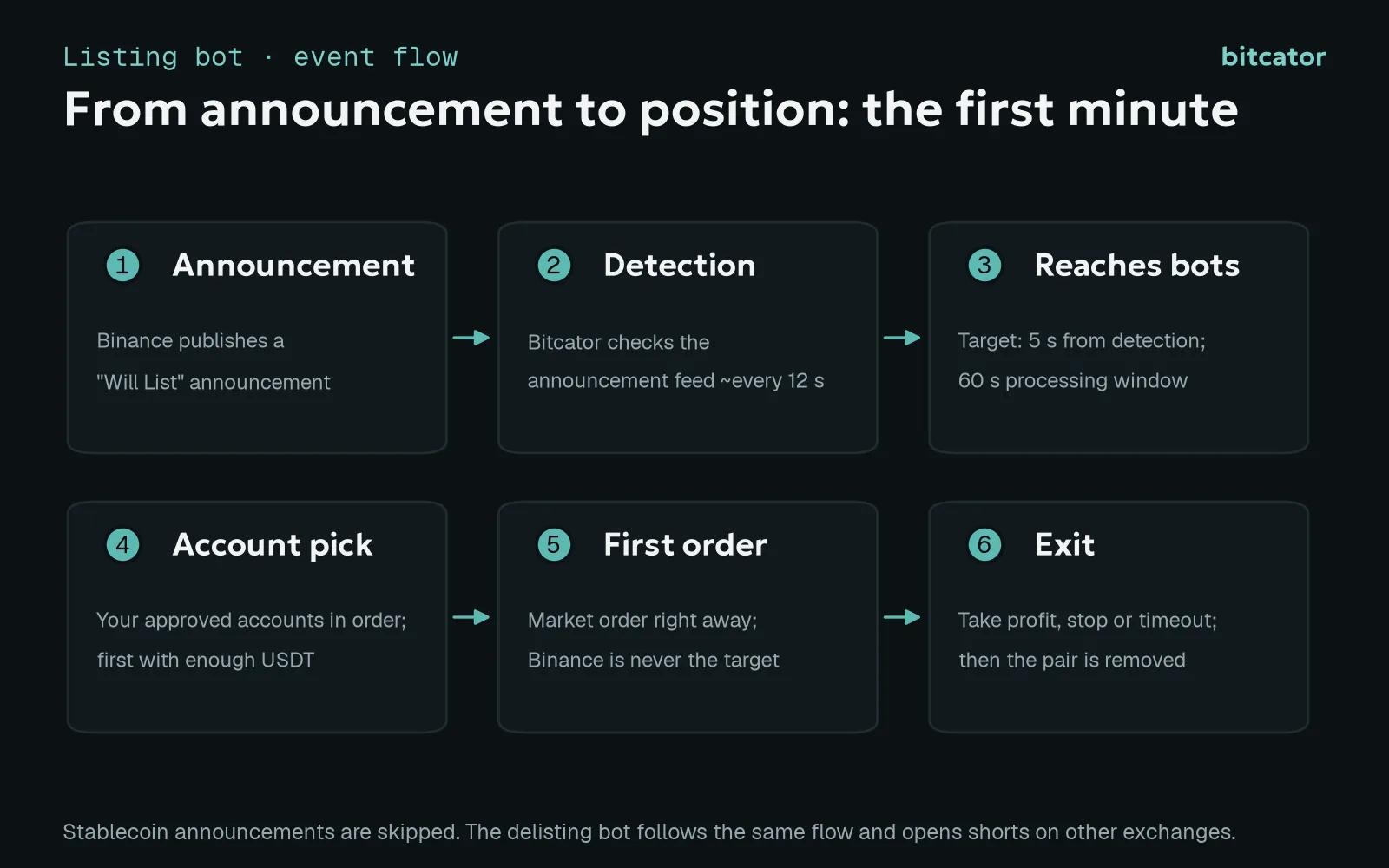
How a listing bot reacts. The delisting bot follows the same flow with short positions.
The announcement. Binance publishes a new listing (or delisting) announcement. Announcements about futures, margin or other products do not count; only "Will List" and "Will Delist" announcements do. Stablecoin listings are skipped.
Detection. Bitcator checks Binance's announcement feed about every 12 seconds, reads the coin from the announcement and records which of the other seven exchanges list it, on spot and on USDT-M perpetuals.
Delivery to bots. The event reaches running bots with a target of five seconds from detection. A bot only acts on an event within 60 seconds of detection; anything later is logged and ignored, because a listing trade that starts several minutes late is a different, worse trade.
Account selection. The bot goes through the exchange accounts you approved for it, in your order, and picks the first one that lists the coin on the bot's market and has enough free USDT for the first order. One pair is traded on one account.
First order. The first order is a market order, placed right away. Binance itself is never the target: it is the exchange making the announcement, and the coin usually is not tradable there yet.
Exit. From here the trade follows the bot's normal rules: take profit, stop, trailing, maximum duration. When the trade closes, the pair is removed from the bot, so one announcement produces one trade.
Delisting bots and delist protection
A delisting bot does the same with the opposite side: on a "Will Delist" announcement it opens a short on USDT-M perpetuals on your other exchanges, where the contract still trades.
Delisting news also protects every other bot. As soon as a delisting is announced, Bitcator blocks new spot and long entries (and DCA orders) on that coin in all bots, and bots with Delist protection enabled sell their spot and long positions in that coin right away. Short positions are left alone.
Options worth knowing
Fall back to spot. For a listing bot trading futures long: if a long cannot be opened on an account (for example because the perpetual does not exist yet), the bot buys the coin on spot instead.
Paper mode without API keys. A listing or delisting bot can run on paper with a list of exchanges instead of accounts (Binance cannot be selected), so you can watch real announcements trigger simulated trades before you commit funds.
Plan. Listing and delisting bots are part of the Premium plan. Because their trigger is an announcement rather than a price, they cannot be backtested; paper mode is the way to rehearse them.
What the first minutes can look like
We cannot show you every exchange's order book at the moment of an announcement. What we can show is the most violent part of the story: the first minutes after trading opens. Here is ZAMA/USDT on Binance spot, from the minute trading started on 2 February 2026 at 13:00 UTC:
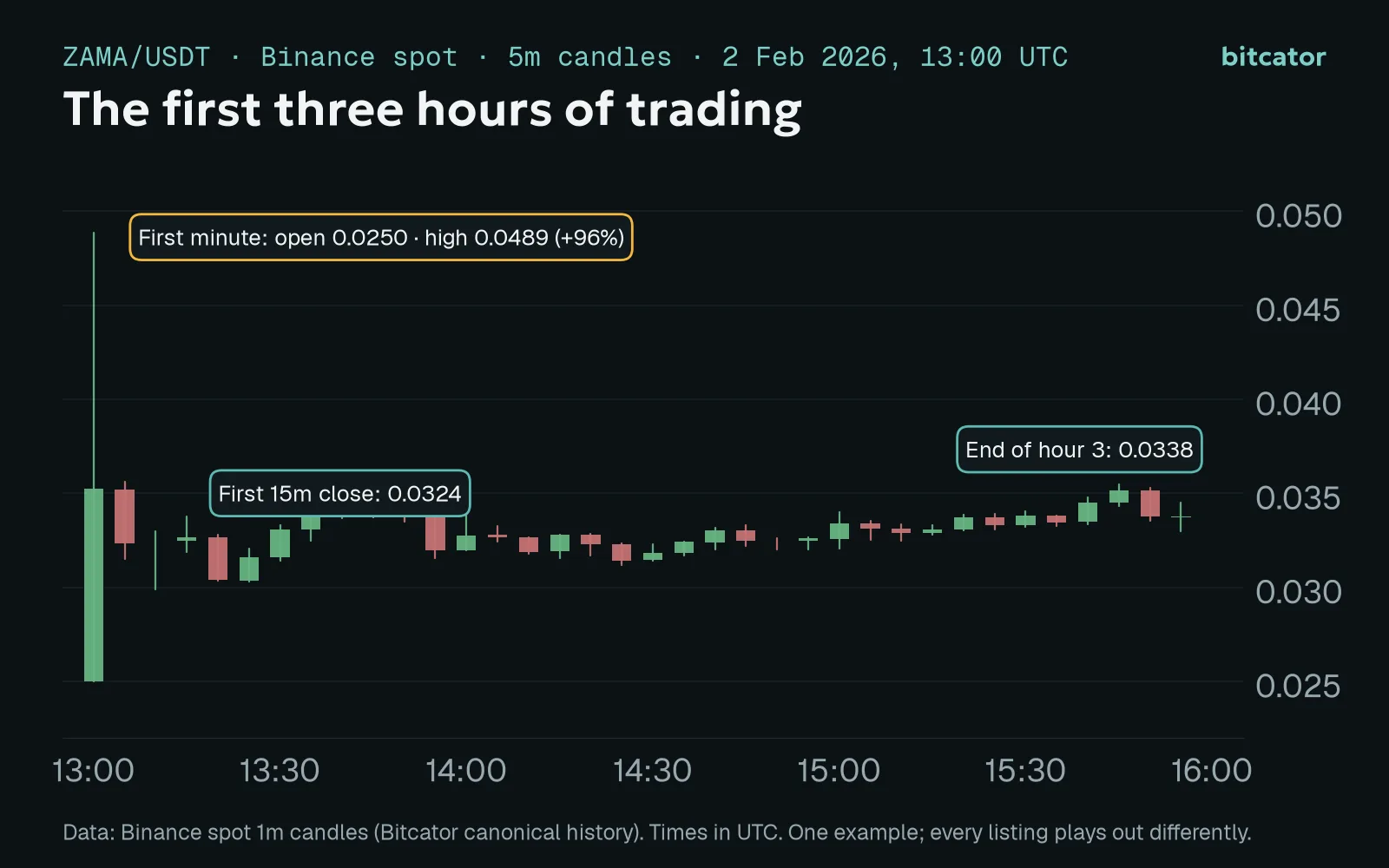
Real 1-minute data from Binance spot, shown as 5-minute candles. Times in UTC.
In the first minute, the price opened at 0.0250 and traded as high as 0.0489, about 96% higher, before closing the minute at 0.0367.
The first 15 minutes closed at 0.0324, a third below that first-minute high.
Three hours later the price was 0.0338. Nobody who bought the first-minute high was back to break-even.
This is one listing, and every listing is different: some keep climbing for days, some never trade above their first print. But the shape is common enough to plan for. The first minutes combine the widest price range, the thinnest order books and the most market orders. Two lessons follow for any automated listing strategy:
Speed matters most before trading opens elsewhere. The listing bot buys on the exchanges where the coin already trades, at the moment of the announcement, which can be well before the opening shown above. By the time the coin opens on Binance, the easy part of the move may already be in the price.
The exit plan matters more than the entry. A take profit that is reachable, a stop that is not inside normal noise, and a maximum trade duration are what turn a fast entry into a trade with a defined risk.
Settings that keep a fast trade sane
Size small and fixed. Use an order amount you would accept losing a large part of. Thin order books mean slippage can be far larger than on BTC; a market order for a size the book cannot absorb fills at worse and worse prices.
Prefer a simple exit. A percentage take profit, possibly with a trailing take profit, is easier to reason about than an indicator exit on a coin with almost no price history. Indicators need history, and a new listing has none.
Use a stop with spike protection. New listings wick constantly. A stop that waits a few seconds and checks again avoids being closed by a single print, while still protecting you from a real reversal.
Set a maximum trade duration. If neither the target nor the stop is hit within a few hours or days, the original reason for the trade is gone. Closing on time keeps capital from being stuck in a coin you bought for a one-day event.
Approve accounts deliberately. The bot uses the first approved account that qualifies. Put the exchanges with the deepest markets for new coins first, and keep enough free USDT there for the first order.
Run it on paper first. Watch a few real announcements trigger paper trades. You will see how often your exchanges list announced coins in advance, how much prices move before you would have entered, and how your exit settings behave.
And pump and dump bots?
If you want to react to sudden price moves on pairs you choose, rather than to announcements, pump and dump bots measure the move against the close a set number of minutes ago (1 to 200) and enter when it exceeds your threshold. They work on price, so unlike listing bots they can be backtested.
Listing bots are a tool for one of the most extreme moments in a coin's life. Treated as a fixed-risk, rules-first trade, they can be run calmly. Treated as a lottery ticket, they usually behave like one.
This article is for educational purposes only and is not investment advice. Trading newly listed or delisted crypto assets carries a very high risk of loss. Past price behaviour, including the example above, does not predict future listings.