Spot or USDT-M perpetuals for your bot? Leverage, funding and liquidation in plain numbers
October 4, 2026

Every Bitcator bot runs either on spot or on USDT-M perpetual futures. The strategy rules are the same in both: entries, DCA, take profit, stops, trailing. What changes is what you actually hold, what can go wrong, and which costs appear in your account that are not in your strategy.
This guide compares the two markets for automated trading, with worked numbers for leverage and liquidation, and a checklist for moving a strategy from spot to perpetuals without surprises.
The short version
Spot means you buy the coin itself. The bot can only go long; the worst case is that the coin falls and you hold it at a loss. There is no liquidation and no funding. You need the full order amount in USDT.
USDT-M perpetuals are contracts that track the price, settled in USDT. The bot can go long or short, uses leverage (you choose 1× to 125× in the builder; many pairs allow less on the exchange), and the position can be liquidated by the exchange if losses eat through its margin. Positions also pay or receive funding at regular intervals.
Choose spot when you want to accumulate or trade long without liquidation risk. Choose perpetuals when you need a short side (dump bots, delisting bots, short DCA), or when you want to keep less capital on the exchange per position and accept the risks that come with it.
The most important rule: the order amount is the position size
In Bitcator, the order amount is the notional size of the position, in USDT. Leverage does not multiply it. A 1,000 USDT order at 10× opens a 1,000 USDT position and locks roughly 100 USDT of margin; it does not open a 10,000 USDT position.
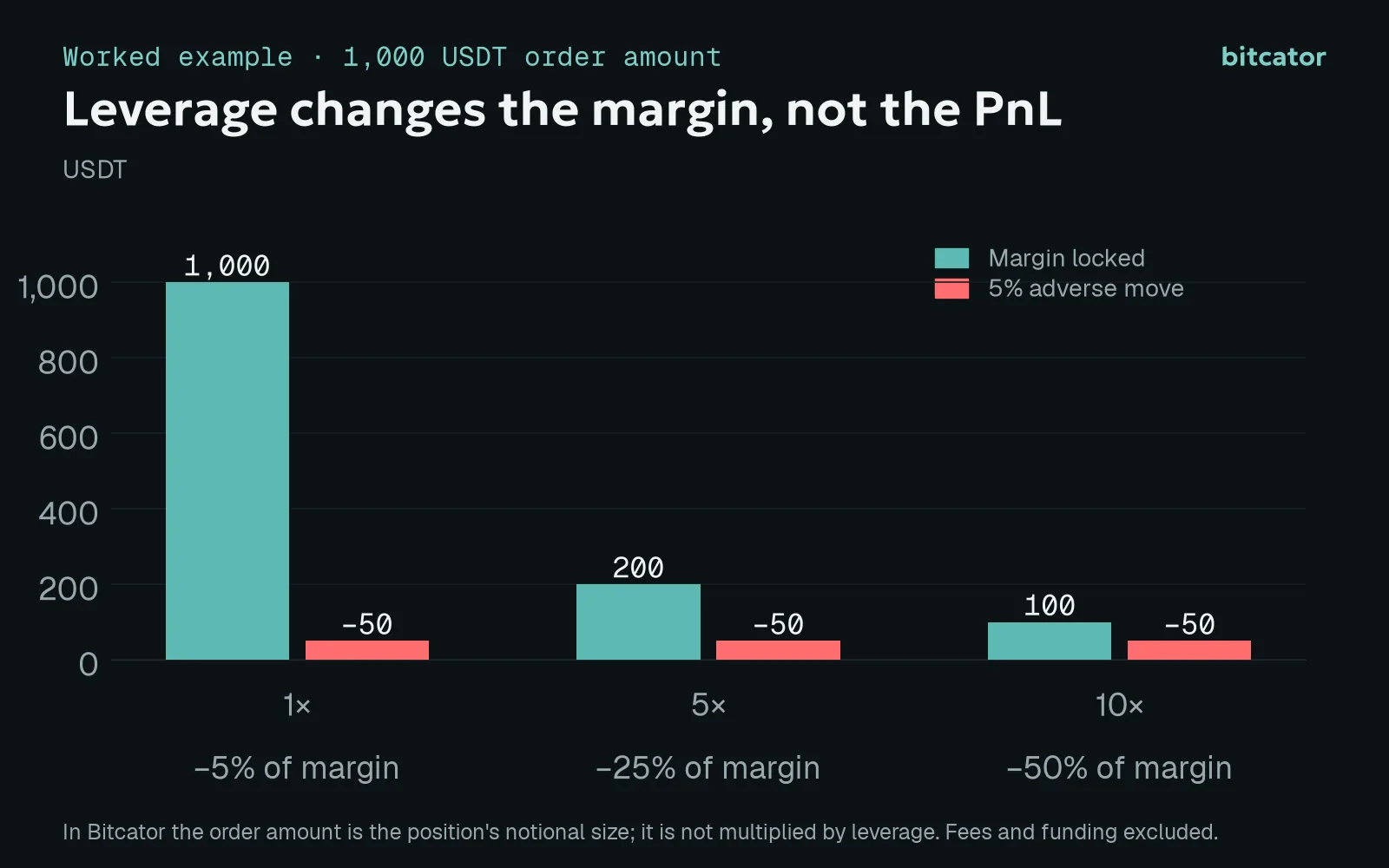
Worked example. Fees and funding excluded.
This has a useful consequence. For the same order amount, leverage does not change your profit or loss in USDT. A 5% adverse move costs 50 USDT on a 1,000 USDT position at 1×, at 5× and at 10×. What leverage changes is how much margin is locked and therefore how large that loss is relative to the margin: 5%, 25% or 50%. The builder shows this directly: at n×, a 1% price move changes your margin by n%.
So leverage is not a way to "make more" from a given strategy. It is a way to lock less margin per position. That freed capital is only safe if you do not immediately use it to open bigger or more positions.
How close is liquidation?
Liquidation happens when the loss on an isolated position approaches the margin behind it. As a rough rule for an isolated long, the price move to liquidation is about 100 ÷ leverage percent, minus the exchange's maintenance margin.
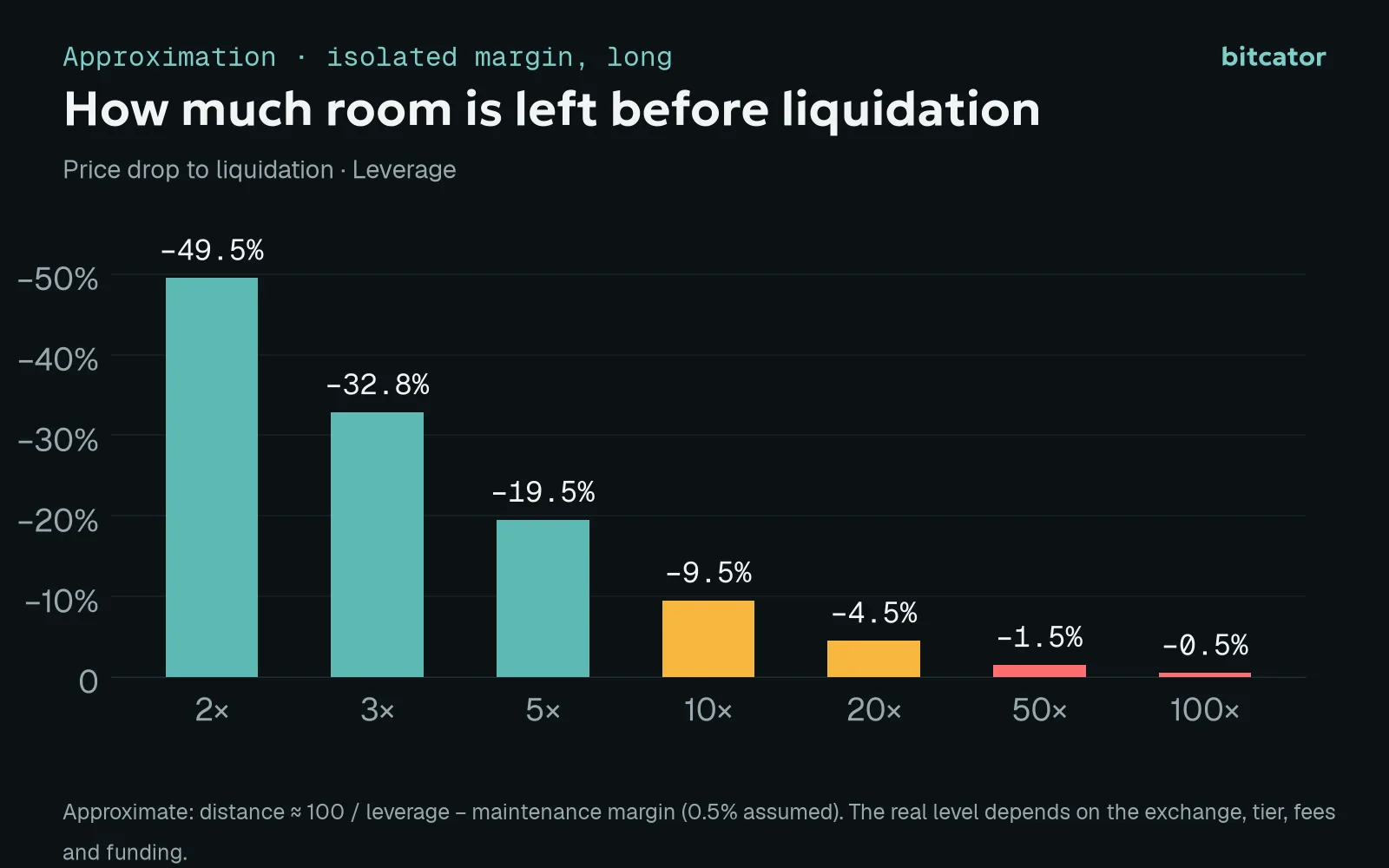
Approximation with a 0.5% maintenance margin. Real levels depend on the exchange, the position tier, fees and funding.
At 2× you have room for a drop of about half.
At 5×, about 19.5%.
At 10×, about 9.5%: less than the 16% fall BTC had within a single day on 10 October 2025.
At 50×, about 1.5%: ordinary noise for many altcoins.
Cross margin uses your whole futures balance to support the position, which pushes liquidation further away but puts the whole balance at risk. Isolated margin limits the damage to the margin of that position. For bots that run unattended, isolated margin with moderate leverage is usually the easier risk to reason about.
DCA on perpetuals needs extra care
A DCA ladder is designed to keep buying as the price falls. Leverage shortens how far it can fall. The five-order ladder from our DCA guide covers a 15.3% drop from the first fill. At 10× isolated, the approximate room before liquidation, about 9.5% from the average, is smaller than the depth the ladder is designed for. Depending on how the average moves as orders fill, the position can be liquidated before the last orders are ever used.
Before running a DCA strategy on perpetuals:
Compare Covers a drop of in the builder with the liquidation distance at your leverage. The ladder should finish, and the stop should sit, well before liquidation.
Remember that a Bitcator stop is evaluated by the bot and sent as a market order when it triggers. Liquidation is executed by the exchange. Keep a safety margin between the two so that slippage in a fast market cannot carry the stop past the liquidation price.
The Only after all DCA orders stop option makes the most sense when the whole ladder fits comfortably inside the liquidation distance.
Funding: the cost that is not in your strategy
Perpetual futures have no expiry. To keep their price close to the spot price, longs and shorts exchange funding payments at regular intervals, often every 8 hours, on some contracts more often. When funding is positive, longs pay shorts; when it is negative, shorts pay longs. The rate changes constantly and can be large during strong trends.
Two practical points:
Funding is settled by the exchange directly on your account. It is not part of the bot's take-profit decision, and backtests do not include it. For strategies that close within hours this is usually small; for positions held for days or weeks it can matter a lot.
If a strategy is long most of the time in a market where funding is persistently positive, part of its edge goes to funding. A maximum trade duration limits how long a position can keep paying.
What else is different
Short side. Only perpetuals let a bot profit from falling prices: short DCA, dump bots and delisting bots all need them.
Clean closes. Bitcator sends closing orders on perpetuals as reduce-only on the correct position side, so a close can never accidentally open a position in the opposite direction.
Signals. Indicator values come from the most liquid market for that pair and market type; orders, targets and stops use your own exchange's price.
Account set-up. Futures trading must be enabled on the exchange account and on the API key. Each exchange has its own futures permission; the API key guide in the exchange form lists it.
Moving a spot strategy to perpetuals
Start at 1× to 3×. Get the same results as on spot before using leverage for capital efficiency.
Keep the order amounts. They are the position size. Do not raise them just because the margin per position fell.
Recheck the worst case. The builder's worst-case capital is notional; divide by leverage for the margin, then compare the ladder depth with the liquidation distance.
Set a stop well inside liquidation, with spike protection if the pair wicks often.
Watch funding on the pairs you trade if you hold positions for days, and use a maximum trade duration.
Rehearse on paper, which simulates fills, fees and slippage on live prices.
Perpetuals are a sharper tool than spot. Used with moderate leverage and a stop that respects the liquidation price, they add the short side and capital efficiency. Used as a multiplier for position size, they mostly multiply mistakes.
This article is for educational purposes only and is not investment advice. Leveraged trading of crypto derivatives carries a very high risk of loss, including the loss of all margin. Liquidation figures above are approximations; always check your exchange's rules.