Trailing entry, trailing take profit and trailing stop, explained with real prices
October 4, 2026

A fixed level is easy to understand: buy at 66,800, sell at 66,450, stop at 63,200. It is also blind. A fixed take profit sells the first time the target prints, even if the market is in the middle of a run. A fixed entry buys the first time the trigger prints, even if the price is still falling hard.
Trailing tools replace a fixed level with a moving one that follows the price at a distance you choose. Bitcator has three of them, and they are often confused because they share a name:
Trailing entry waits for the price to turn before it buys.
Trailing take profit keeps a winning trade open after the target and sells on the first meaningful pullback.
Trailing stop follows the peak of a trade that is in profit and closes it when the price falls back by your stop distance.
Below, each one is explained with the exact rule the bot applies, then replayed on real BTC/USDT 1-minute candles from Binance spot. The replays evaluate four prices inside every 1-minute candle, the same way Bitcator backtests do, and leave out fees to keep the numbers clean.
Trailing entry: buy the turn, not the fall
Without trailing, a percentage entry buys the moment its trigger is reached. With Trailing entry on, reaching the trigger only arms the entry:
The trigger is reached, for example the price is 5% below the close of the last closed 4h candle.
The bot starts tracking the lowest price from that moment on.
Every new low moves the anchor down. The bot buys only when the price bounces back by the trailing percentage from the lowest point.
Short bots mirror this: they track the highest price and sell short once the price has fallen back by the trailing percentage. The trailing distance is either a percentage you set or Automatic, which uses a fixed 0.5% distance. Trailing applies to percentage entries, including the added orders of a DCA ladder; indicator entries do not trail.
Here is how three versions of the same entry behaved on 5 February 2026, a day when BTC fell from about 70,000 to 60,000:
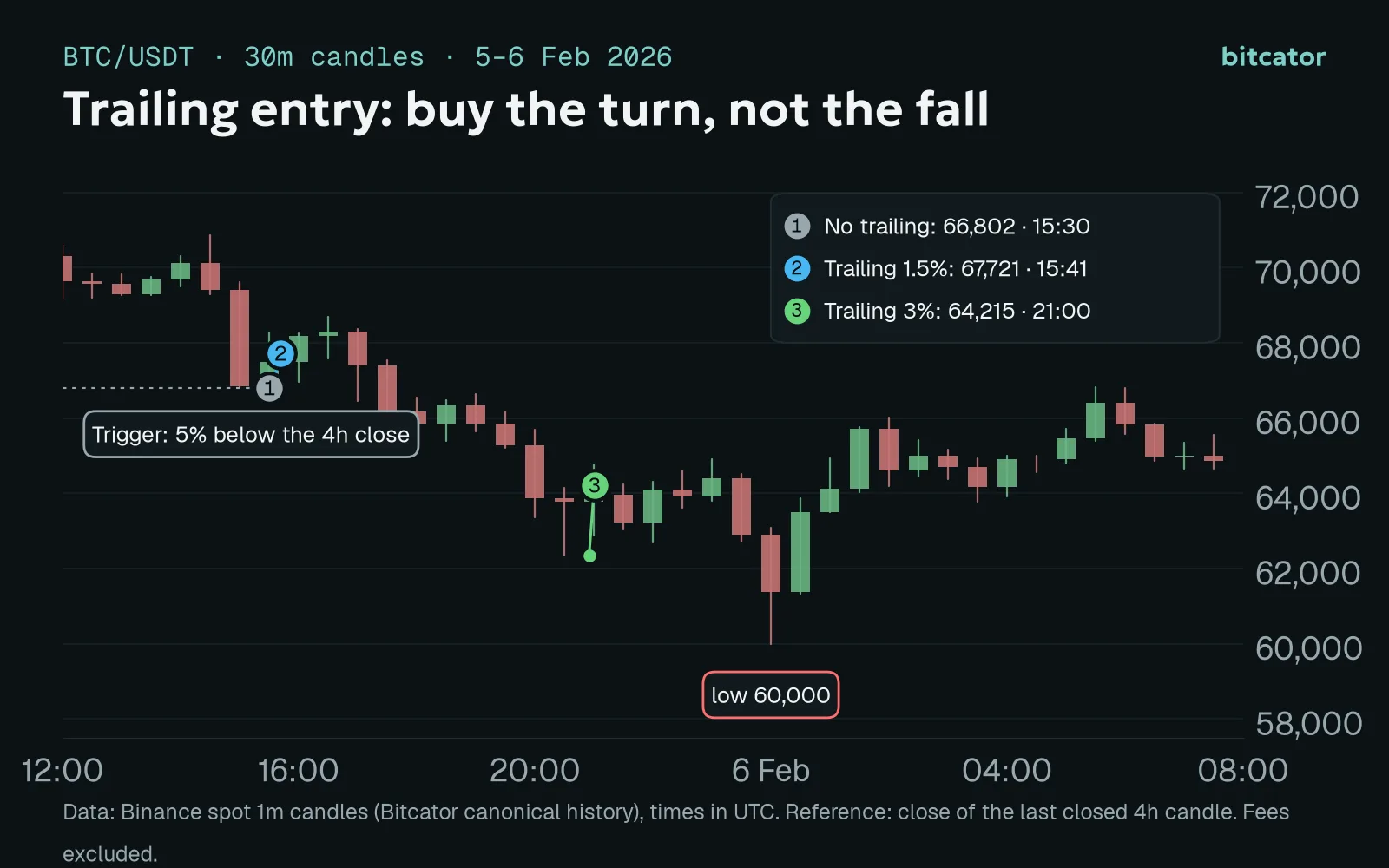
Real candles, times in UTC. Reference: the close of the last closed 4h candle.
No trailing: the trigger is hit at 15:30 UTC and the bot buys at 66,802.
1.5% trailing: the price dips only to 66,720, bounces 1.5% within ten minutes and the bot buys at 67,721 at 15:41: higher than without trailing.
3% trailing: the small bounce is not enough. The anchor keeps falling with the price until 62,345, and the bot buys the 3% rebound at 64,215 at 21:00.
The lesson is not "use 3%". On this day the deeper trail waited through the first leg of the fall; on a day with a sharp V-shaped bottom, the same 3% would have bought well above the low or after the move was over. A trailing entry trades a slightly worse price in calm markets for protection against buying into a falling knife. Note also that none of these entries caught the 60,000 low. Trailing is a filter, not a forecast.
Trailing take profit: let the winner run, then leave
A fixed take profit sells as soon as the price is a set percentage above the average entry. With Trailing take profit on, reaching the target only arms the exit:
The price reaches the take-profit level, measured from the average entry.
The bot tracks the highest price from there.
It sells when the price falls back from that peak by the trailing distance.
One safeguard matters here: when the trailing exit fires, the bot checks again that the trade is still in profit after fees. If it is not, for example because the trailing distance was larger than the target, the trailing is cancelled and the trade goes back to normal monitoring. A take profit never closes a trade at a loss. And while the trailing exit is armed, the stop keeps running and takes priority.
On 19 August 2026 BTC started a rally that took it from about 64,500 to 79,500 in two days. The same long entry at 64,516 (12:00 UTC on the 19th), three exits:
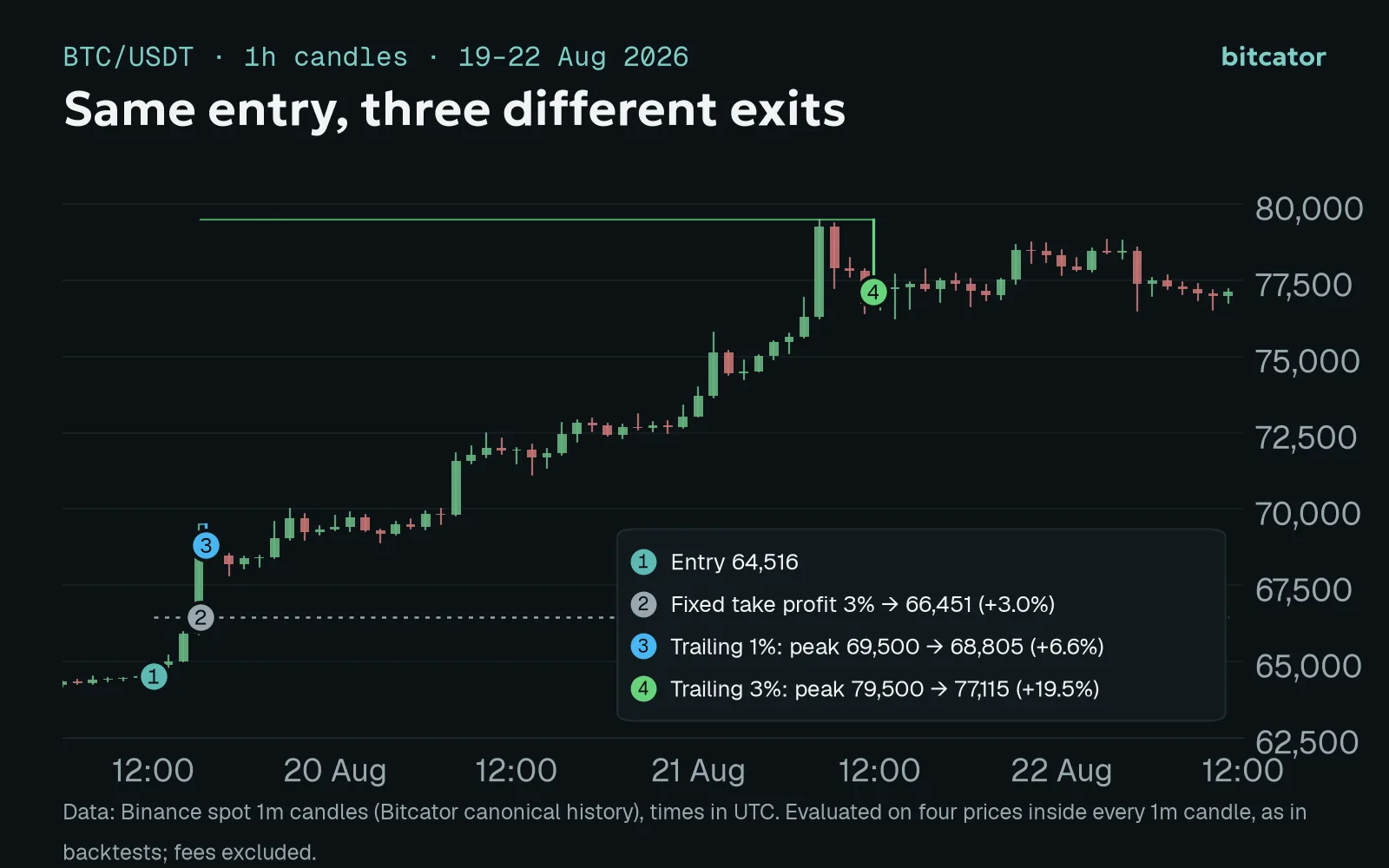
Real candles, times in UTC. Fees excluded.
Fixed 3% take profit: sells at 66,451, +3.0%, at 15:06 the same afternoon.
3% target + 1% trailing: arms at 66,451, follows the spike to 69,500 and sells the first 1% pullback at 68,805, +6.6%, twenty-two minutes later.
3% target + 3% trailing: rides through the evening and the next day, follows the peak to 79,500 on 21 August and sells at 77,115, +19.5%.
Before reading too much into the last number, remember that it is hindsight. In a rally that fades right after the target, a 3% trail gives back up to 3% of the peak, and a 1% trail keeps more of a small move. The distance should match how much the asset normally swings. A trail tighter than ordinary noise turns into a fixed take profit with extra steps; a trail wider than the move you expect is a fixed take profit you will rarely reach.
Trailing stop: protect a trade that is already in profit
The trailing stop lives in the stop section, and it works differently from the two tools above:
It uses the stop percentage as its distance; there is no separate trailing value.
It follows the highest price since the last fill (the lowest, for shorts), so every DCA order restarts it from the new fill.
It only closes the trade when the price is above the average entry by at least 0.3%, so it is a profit-protecting exit, not a second stop loss. Below that, the regular percentage stop does its job.
On the same 19 August entry, a 2% trailing stop with a distant take profit behaved like this:
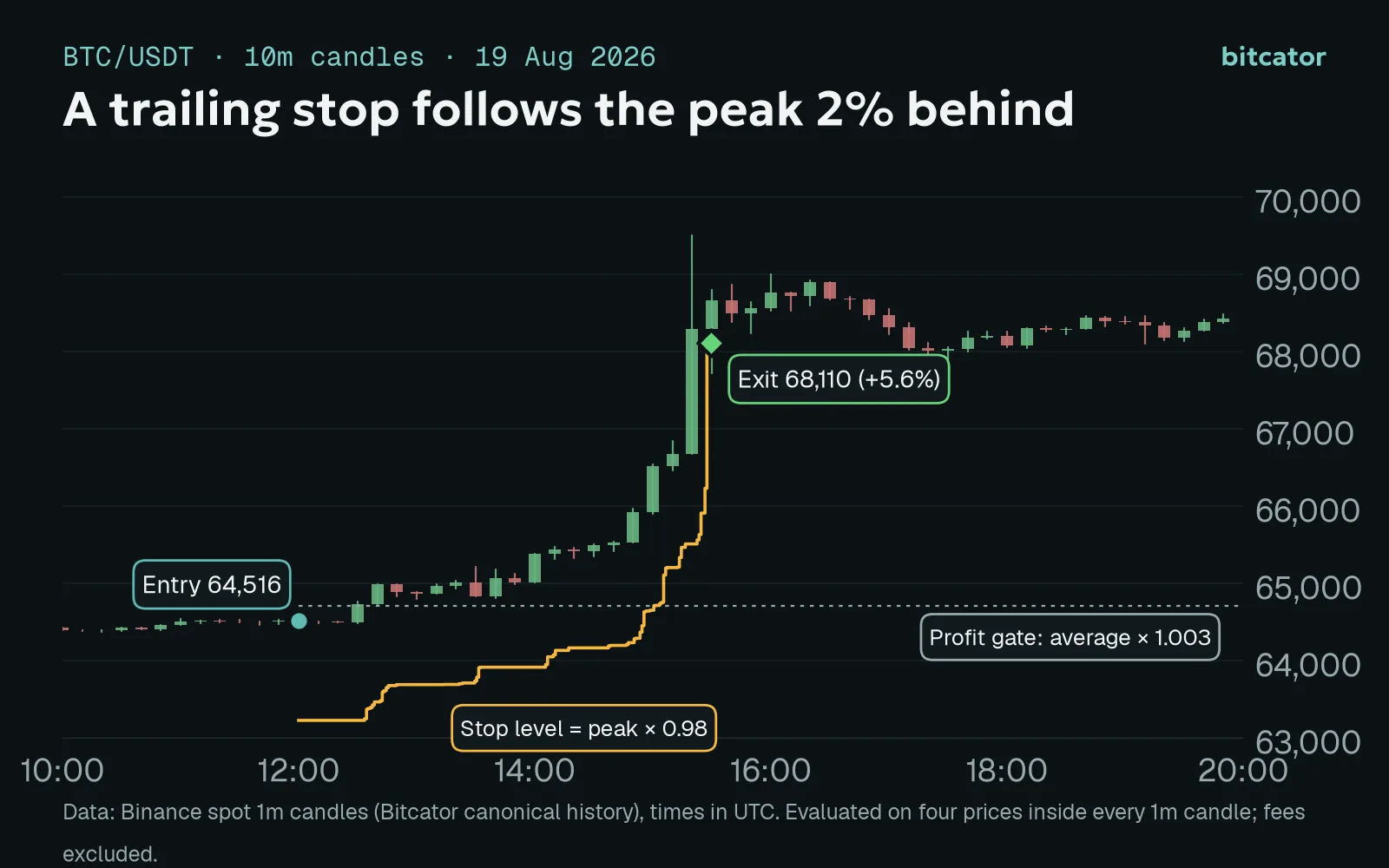
Real candles, times in UTC. Fees excluded.
The stop level climbs with every new high: 2% below the peak. When BTC spiked to 69,500 and fell back, the level was 68,110, and the trade closed there at 15:29, +5.6%. With a 3% distance instead, the stop would have stayed in the trade until 21 August and closed at 77,115, the same exit as the 3% trailing take profit.
So what is the difference between a trailing stop and a trailing take profit? Mainly when they start protecting the trade. The trailing take profit does nothing until the target is reached. The trailing stop starts following the peak from the first fill and can close a trade with a small profit long before any target. Many traders use both: a trailing take profit for the planned exit, and a trailing stop as a safety net in case the trade turns before the target.
Choosing distances that make sense
Start from the asset's normal noise. Look at typical pullbacks on the timeframe you trade. For BTC on a calm day a 0.5–1% trail can be reasonable; for a small-cap altcoin the same value may fire on every wick.
Keep the take-profit trail smaller than the target. If the trail is larger than the target, a pullback can bring the trade back to break-even. Bitcator cancels the trailing rather than sell at a loss, but you lose the target you aimed for.
Remember the fees. At a 0.1% fee per order, a round trip costs about 0.2%. A trailing stop closes only above the average + 0.3%, but a very tight trail still leaves little after fees.
Test before trusting. Run the same configuration in a backtest with different trailing values, then on paper. Backtests evaluate four prices inside every 1-minute candle; live bots react to every price update, so live trailing can trigger a little earlier or later than the backtest.
Trailing tools do not make a strategy profitable on their own. What they do well is replace "I'll sell when it looks like the top" with a rule you can test, size and repeat.
This article is for educational purposes only and is not investment advice. Trading crypto assets carries a high risk of loss. Past results, including backtests and the replays above, do not guarantee future results.