Percentage DCA, done right: a ladder built to survive the drop
October 4, 2026

"DCA" means two different things in crypto. For a long-term investor it is a calendar habit: buy a fixed amount every week, whatever the price. For a trading bot it is something sharper: open a position, then add to it in planned steps while the price moves against you, so that a smaller rebound is enough to close the whole position in profit.
This guide is about the second kind. It explains exactly how a percentage DCA ladder behaves in Bitcator, walks through the arithmetic of a five-order ladder, and then replays that ladder on a real BTC/USDT sell-off from February 2026, including what would have happened with two different stop settings. The goal is not to make DCA look good. It is to show where it helps, where it hurts, and which numbers you have to decide before you start.
How a percentage DCA ladder works
A DCA bot in Bitcator runs four rules on every price update:
First order. Either the bot buys right away (Enter immediately), or it waits until the price has fallen a set percentage below the close of the last closed reference candle. The reference candle is 4h by default and can be any timeframe.
Added orders. Each further order is placed when the price falls a set percentage below the previous fill: not below the first fill and not below the average. Every step is measured from the rung above it.
Take profit. The exit target is measured from the average entry of all filled orders. It only fires when the trade is in profit after fees; a target smaller than the round-trip fees is raised to break-even.
Stop (optional). A stop can be measured from the average entry (the default) or from the last fill, and it can be told to wait until every DCA order has filled.
You choose the number of orders (2 to 50, the first order included), the amount of each order in USDT and the price step of each added order. Two optional multipliers fill these in for you: Scale order amounts makes each order the first one times multiplier^n, and Scale price steps does the same for the distance between rungs.
A short-side DCA on perpetual futures mirrors everything: orders are added as the price rises, and the target sits below the average.
The ladder in numbers
Here is the ladder used in the rest of this article: five orders, a first order of 100 USDT, a first DCA step of 2%, and both multipliers set to 1.5.
Order 1: 100 USDT at the entry price
Order 2: 150 USDT, 2% below order 1
Order 3: 225 USDT, 3% below order 2
Order 4: 337.50 USDT, 4.5% below order 3
Order 5: 506.25 USDT, 6.75% below order 4
Because each step is measured from the previous fill, the drops compound. The last order fills only after the price has fallen 1 − (0.98 × 0.97 × 0.955 × 0.9325) ≈ 15.3% from the first fill. The bot builder shows this number as Covers a drop of, next to Per trade (all orders), which here is 1,318.75 USDT.
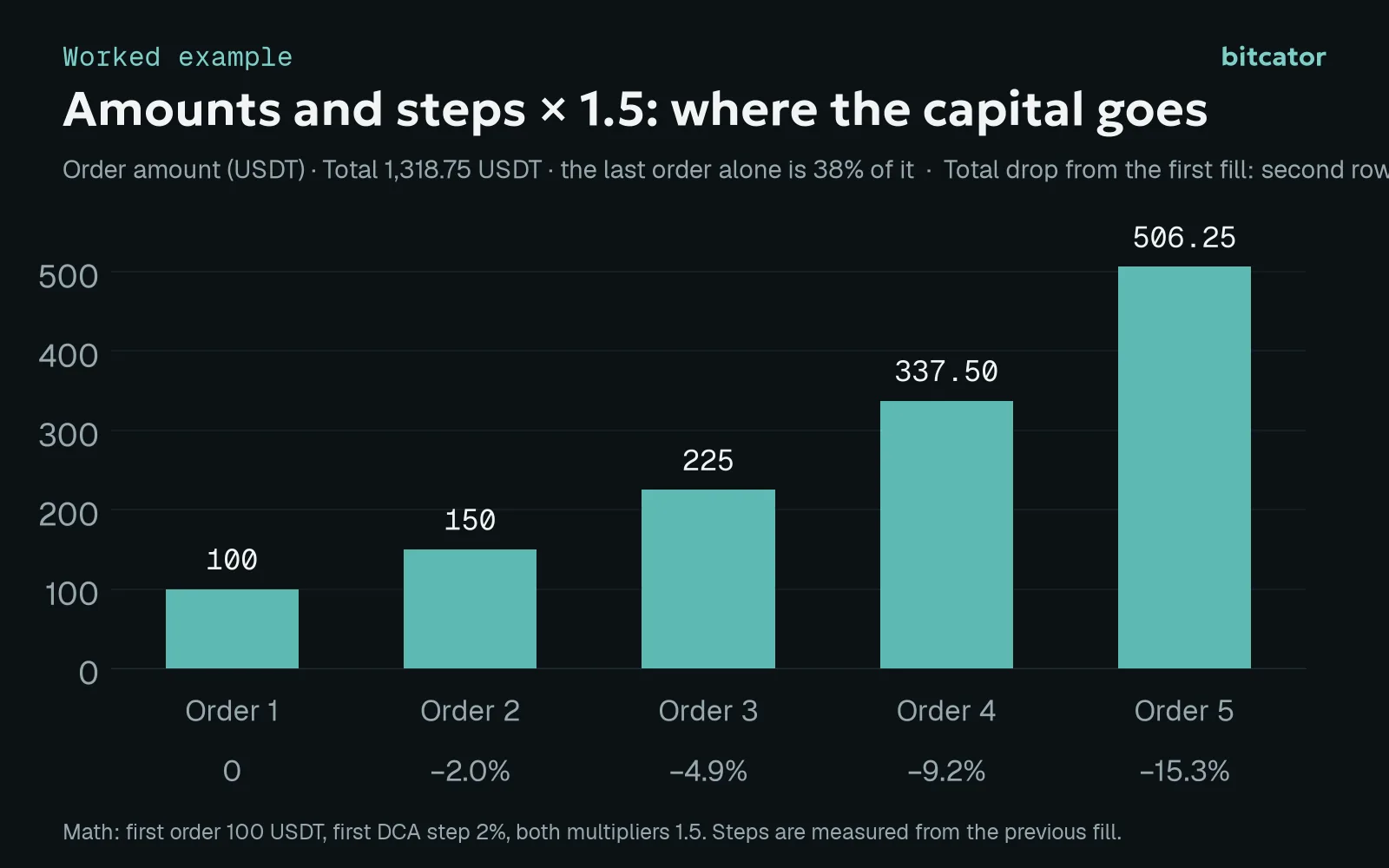
Worked example. The last order alone is 38% of the capital the ladder can use.
Two things stand out. First, most of the money waits at the bottom: orders 4 and 5 together are 64% of the total. That is what pulls the average down quickly when they fill, and it is also why a ladder that is too deep for your account is dangerous. Second, the steps widen as the price falls. With a constant 2% step, five orders would only cover about 7.8%; the multiplier stretches the same number of orders over twice that distance.
There is no universally right multiplier. A higher amount multiplier pulls the average closer to the bottom but concentrates risk in the last rungs. A higher step multiplier covers deeper drops but makes the later rungs fill less often. Decide the depth you want to cover first, then pick the multipliers that get you there with an amount you can afford to have fully deployed.
A real stress test: 4–6 February 2026
To see the ladder under pressure, we replayed it on real BTC/USDT 1-minute candles from Binance spot (the history Bitcator stores for backtests), starting on 4 February 2026 at 12:00 UTC. To keep the arithmetic readable, fills are assumed at the trigger level and every order pays a 0.1% fee.
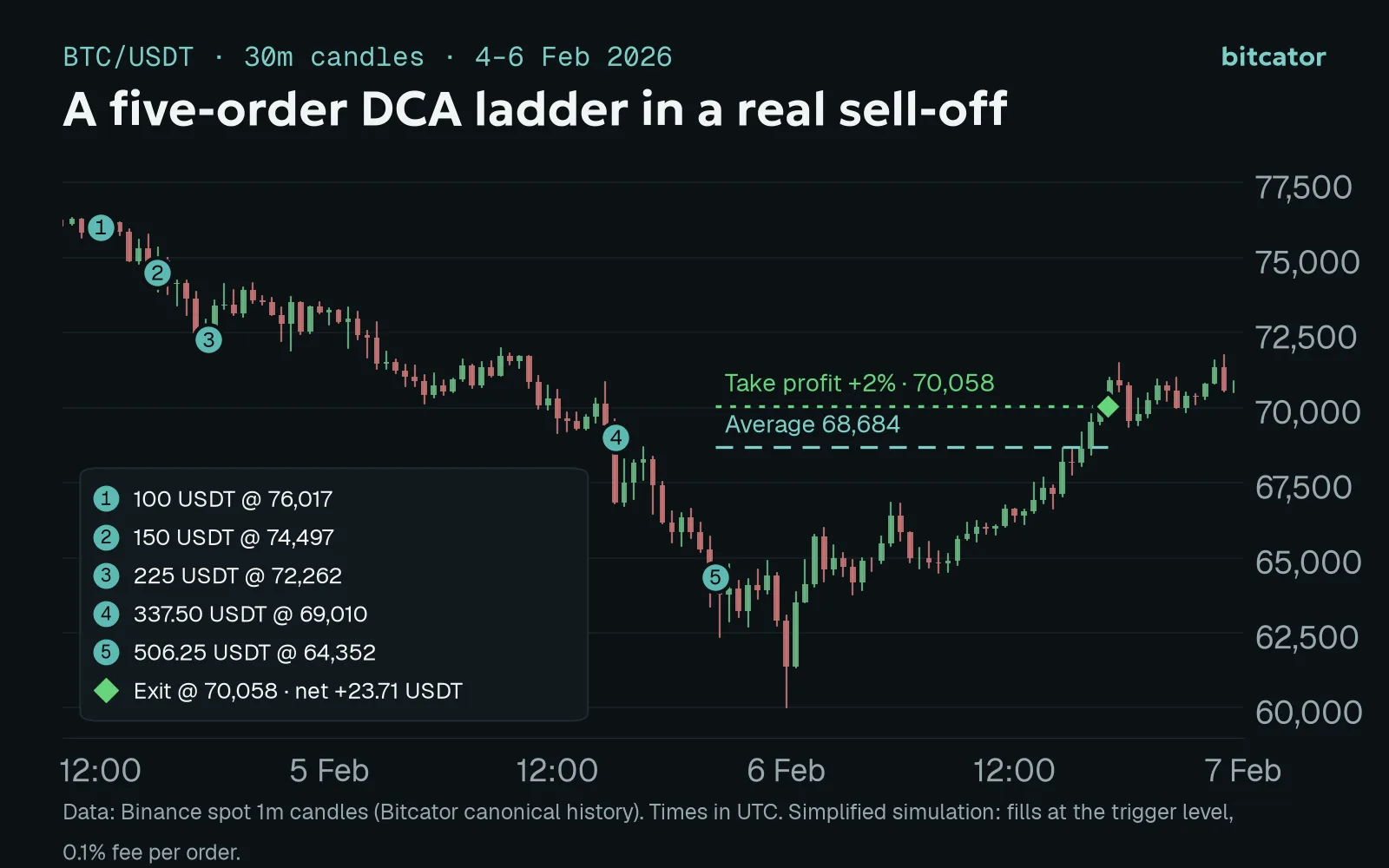
Real candles, simplified simulation. Times in UTC.
The sell-off was not gentle:
4 Feb 12:00: order 1 at 76,017.
4 Feb 14:58: order 2 at 74,497.
4 Feb 17:40: order 3 at 72,262.
5 Feb 15:03: order 4 at 69,010.
5 Feb 20:16: order 5 at 64,352. The ladder is now fully deployed, with an average entry of 68,684.42.
6 Feb, shortly after midnight: BTC trades down to 60,000, 12.6% below the average. The open position shows its worst unrealized result, about −166.74 USDT.
6 Feb 16:53: the price climbs back to 70,058.10, 2% above the average. The bot sells everything: +23.71 USDT after fees.
For comparison, the same 1,318.75 USDT bought in one order at 76,017 would still have been about 7.8% (roughly −103 USDT) under water at the moment the ladder exited. The ladder did not predict the bottom. It simply moved the break-even point 9.6% lower, close enough for an ordinary rebound to reach it.
That is the whole promise of DCA, and also its limit: it buys time and a better average. It does not create a rebound.
The stop decides everything
The run above had no stop. Now add one, with Only after all DCA orders turned on so it cannot fire before the ladder is complete.
Stop 8% below the average (63,189.66): the price touches it at 20:36 on 5 February, twenty minutes after order 5 filled. The trade closes at about −108.03 USDT after fees, hours before the low and the rebound.
Stop 12% below the average (60,442.29): it survives the first leg but fires at 00:14 on 6 February, minutes before the 60,000 low, for about −160.73 USDT.
Neither result means stops are wrong. In a sell-off that keeps going, the same stops are what keep a full ladder from turning into a much larger loss. What the replay shows is that ladder depth and stop distance are one decision, not two. This ladder covers 15.3% from the first fill, and its average sits about 9.6% below the first fill. A stop measured from the average gives you that much less room below the last rung than the ladder suggests.
Some tools that help you place it consciously:
Measured from last fill. If you think in rungs, measure the stop from the last fill instead of the average, and place it beyond where the next rung would have been.
Spike protection. The stop waits for a set number of seconds and checks again, so a single wick does not close the trade. It helps against brief spikes, not against a trend: in this example the 8% level was first touched by a wick and the minute closed back above it, but over the next hours BTC closed below that level dozens of times.
Pause the bot after a losing stop. After a stop closes a trade at a loss, the bot opens no new trades until you restart it. Open positions keep their exits.
A checklist before you start a DCA bot
Pick the depth from history, not hope. Run a backtest over a year of 1-minute data on the pairs you want to trade. On 10 October 2025 BTC fell from 121,662 to 102,000 within the day, a 16.2% drop: deeper than this ladder covers.
Know your worst case. Per trade, a ladder can commit every order. Multiply by the number of concurrent trades you allow. The builder shows Worst case (all trades); that number should be money you can afford to have tied up in falling positions.
Size the target above the fees. At a 0.1% fee per order, a round trip costs about 0.2%. A 2% target leaves room; a 0.3% target mostly pays the exchange.
Decide the stop together with the ladder. Write down where it sits relative to the last rung, and whether it is measured from the average or the last fill.
Use the filters. A minimum 24-hour volume keeps thin pairs out, a daily range guard skips new entries after an unusual 24-hour move, and delist protection sells spot and long positions when Binance announces a delisting.
Rehearse on paper. Paper mode runs the same rules on live prices with simulated orders, fees and slippage, without an API key.
DCA rewards patience and punishes overconfidence. Built with numbers you have checked, it is one of the most transparent ways to automate buying into weakness.
This article is for educational purposes only and is not investment advice. Trading crypto assets carries a high risk of loss. Past results, including backtests and the replay above, do not guarantee future results.