How to backtest without fooling yourself
October 4, 2026

A backtest answers one narrow question: if these exact rules had run over this exact history, what would they have done? That is valuable. It is also very easy to turn into a different, flattering question: which rules would have made the most money on this history? The first is a test. The second is a story you wrote after reading the ending.
This guide is about keeping a backtest honest. It covers what Bitcator's backtests actually simulate, the four classic ways results get inflated (costs, the path inside a candle, look-ahead and overfitting), and a simple routine that turns a single good number into evidence you can act on.
What a Bitcator backtest simulates
It helps to know exactly what the engine does, because every assumption is a place where reality can differ:
Data. Up to a year of real 1-minute candles. For every pair, each minute comes from the exchange that was most liquid for that pair at the time; the result page lists which exchanges were used and when. Higher timeframes (5m, 1h, 4h, 1d…) are built from those 1-minute candles.
Same rules as live. Backtests, paper bots and live bots run the same strategy rules: the same entry reference, DCA steps, fee-aware take profit, stops, trailing and filters.
Several pairs together. Up to five pairs run in lock-step, sharing the bot's limit on concurrent trades, as a live bot would.
Warm-up. Indicators are fed with history from before the start date, and no trade opens during the warm-up.
Costs. Every order pays a 0.1% fee and fills with 0.05% adverse slippage.
Inside the candle. Each 1-minute candle is replayed as four prices: open, low, high, close for a rising candle; open, high, low, close for a falling one.
Live (intrabar) conditions are recalculated at every 1-minute close, and confirmation times are rounded up to whole minutes. The result page says so when it applies.
What it does not simulate is just as important: funding payments on perpetual futures, order-book depth beyond the slippage assumption, exchange outages and partial fills. Listing and delisting bots cannot be backtested at all, because their trigger is an announcement, not a price.
Trap 1: forgetting the costs
Small edges die first. Consider a strategy that trades often and makes an average of 0.30% per trade before costs: 300 trades of 1,000 USDT each.
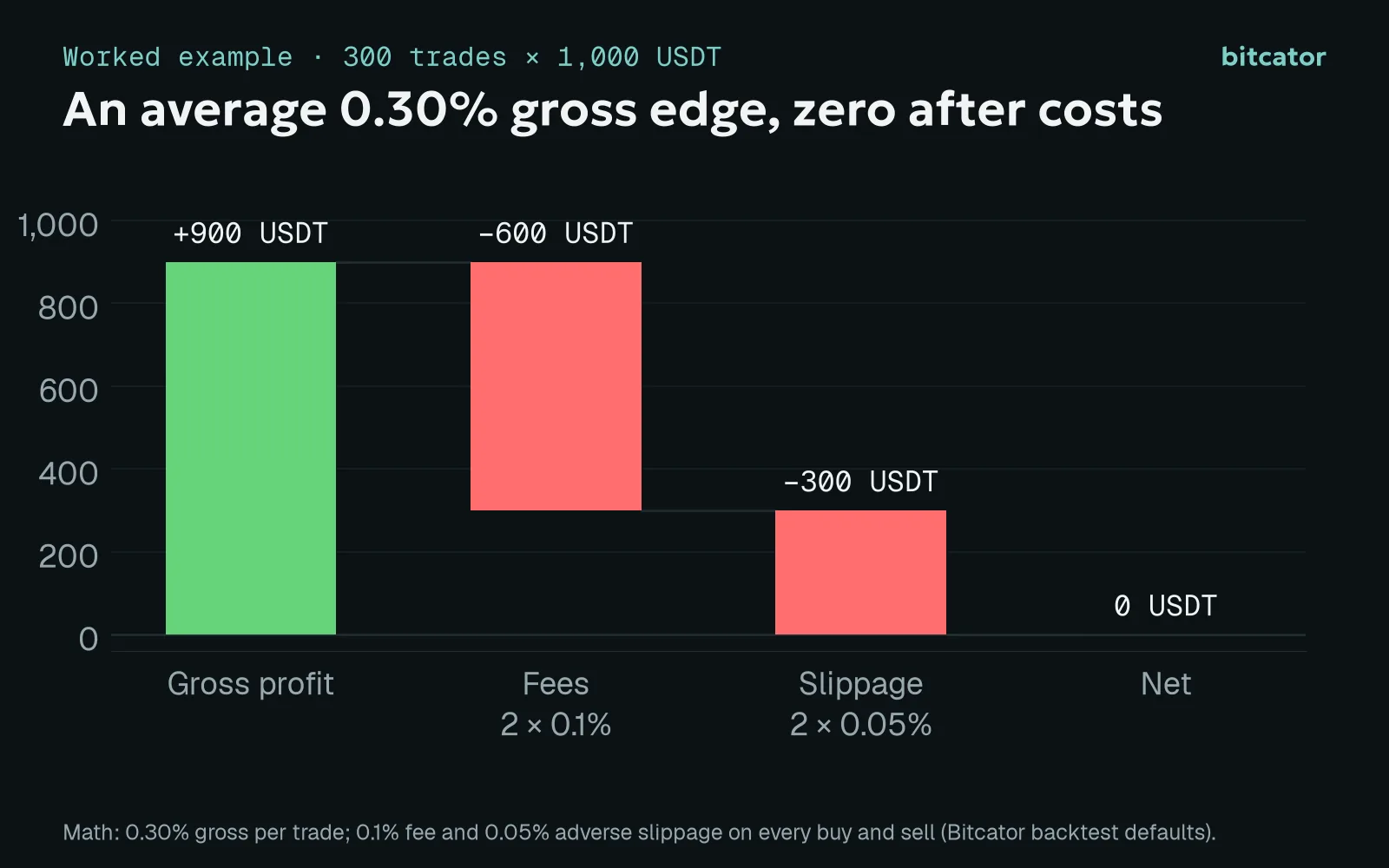
Worked example with Bitcator's default backtest costs.
Gross: 300 × 1,000 × 0.30% = +900 USDT
Fees: 300 trades × 2 orders × 0.1% × 1,000 = −600 USDT
Slippage: 300 × 2 × 0.05% × 1,000 = −300 USDT
Net: 0 USDT
A strategy that grossed 900 USDT on 1,000 USDT trades is, after costs, exactly flat. The higher the trade count, the more a result depends on costs, and the more you should ask whether your real fees are lower or higher than 0.1% (VIP tiers, fee tokens and maker/taker differences all change this).
Two habits help. Prefer targets that are several times the round-trip cost: at about 0.3% per round trip including slippage, a 0.5% target keeps less than half of its gross. And read the fee total on the result page next to the profit, not after it.
Trap 2: the path inside a candle
A 1-minute candle tells you the open, high, low and close. It does not tell you the order in which the high and the low happened. Usually that does not matter. It matters a lot when a take profit and a stop are both inside the same candle's range:
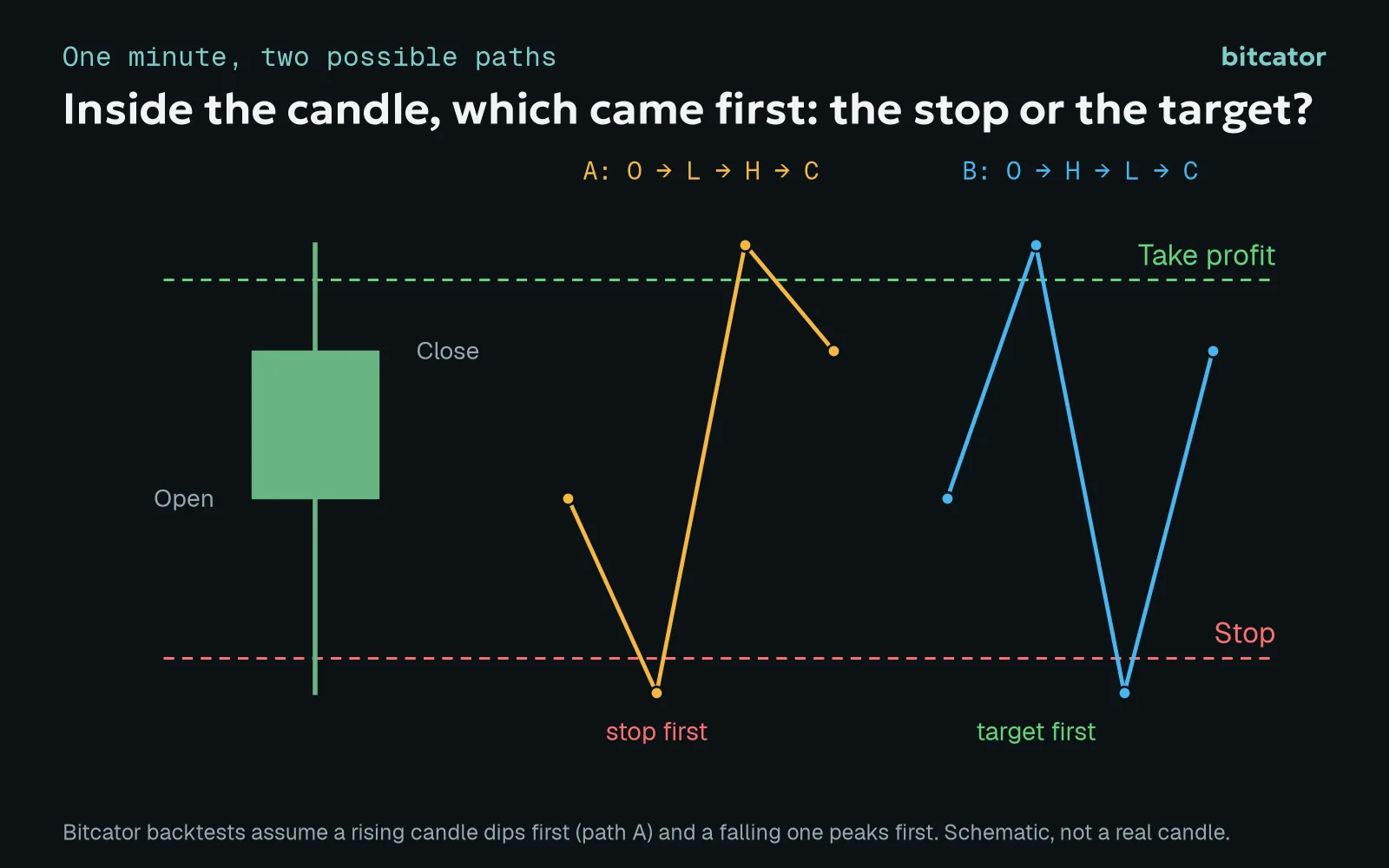
Schematic, not a real candle.
Bitcator's backtest assumes that a rising candle dipped first and a falling candle peaked first. That is a reasonable, consistent convention, but it is still a convention. If your strategy uses tight targets and tight stops, many trades will be decided inside single candles, and the backtest result will depend on that assumption more than on your idea.
The fix is structural, not statistical: give trades room. If your stop and target are only a few tenths of a percent apart, you are testing the candle convention. Widen them until most exits happen over several candles, and the result becomes a property of your rules again.
Trap 3: look-ahead, by the engine or by you
Look-ahead means a decision uses information that was not available at the time. The engine guards against the mechanical kind: percentage entries use the close of the last closed reference candle; indicator conditions in On bar close mode only see closed candles; Live conditions see the forming candle only up to the current minute. Nothing in the simulation reads a future candle.
The dangerous look-ahead is human:
Picking the period after looking at the chart. Starting a backtest right after a crash and ending it at a top will make almost any long strategy look brilliant.
Picking the pairs that did well. Testing only the coins that are popular today quietly removes the ones that faded.
Tuning on the event you remember. If a strategy is shaped to survive one famous wick, it is fitted to that wick.
The defence is to decide the test period and the pair list before you look at results, and to include periods you did not choose because they were convenient.
Trap 4: overfitting
Every parameter you tune is a chance to fit noise. Ten parameters with five values each is almost ten million combinations; one of them will look excellent on any history. The question is not whether you can find a great backtest. You always can. The question is whether the rules keep working on data they were not tuned on.
That is what an out-of-sample test answers. Split your history into a part you develop on and a part you only test on, once.
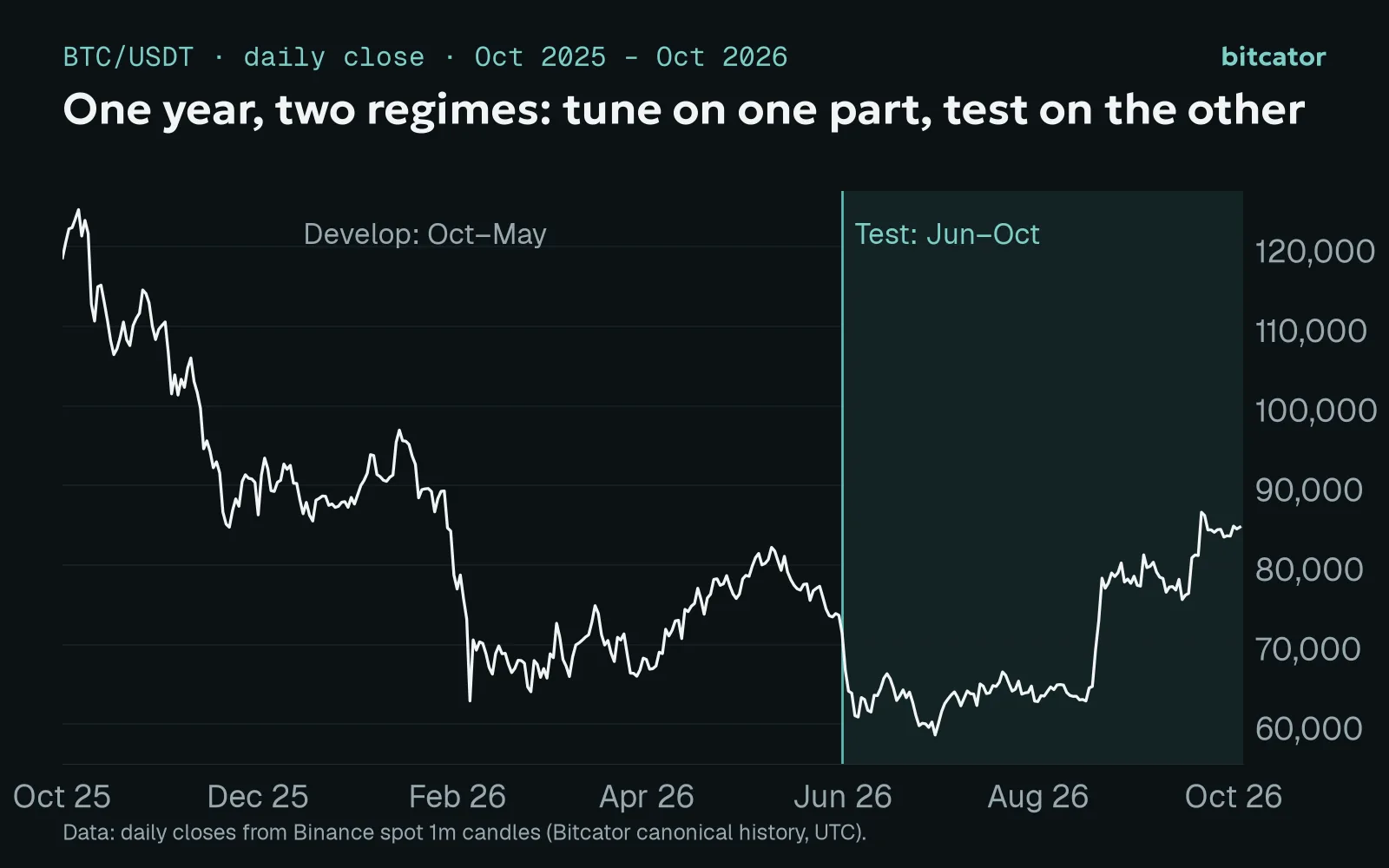
Daily closes built from Binance spot 1-minute candles, UTC.
The last year of BTC shows why this matters. From October 2025 to the end of May 2026, BTC fell from about 118,600 to 73,700 (its highest close, 124,659, came on 6 October 2025), with an average daily move of about 1.7%. From June to early October 2026 it recovered from about 71,400 to 84,800, with a low close of 58,625 on 30 June and calmer days, about 1.4% on average. A long-only DCA bot tuned on the first period was tuned on a falling, volatile market. Testing it on the second tells you whether it learned something general or only learned that specific decline.
A routine that keeps you honest
Write the idea down first. One sentence on why the rules should work, before running anything.
Fix the pairs and the period. Split them into development and test parts and do not look at the test part until the end.
Tune a little on the development part. Few parameters, round values.
Check the neighbours. If 2% works and 1.8% or 2.2% fail badly, you found noise. Good settings sit on a plateau.
Run the test part once. If the result collapses, the honest move is to go back to step 1, not to keep tuning until it passes.
Read more than the total. Number of trades, win rate, fees paid, maximum drawdown and how long trades stayed open (the trade list shows every fill). A profitable backtest with a drawdown you could not sit through is not a strategy you can run.
Rehearse on paper. Paper mode runs the same rules on live prices with simulated orders, fees and slippage. It shows what the backtest cannot: how the strategy behaves on prices nobody has seen yet.
Each account can run backtests on up to five pairs at a time, with two runs queued at once and twenty per day; higher plans move up the queue. The limit is a useful discipline: it pushes you to test ideas rather than to mass-produce parameter sets.
A backtest cannot tell you what will happen. Used carefully, it is very good at telling you what will not work, and that saves real money.
This article is for educational purposes only and is not investment advice. Trading crypto assets carries a high risk of loss. Past results, including backtests, do not guarantee future results.